GoldQuest
Turn everyday work into measurable progress with game-style engagement and continuous reviews.
GoldQuest is a gamified performance management system that turns everyday work into a quest. Objectives become goals, your manager becomes your captain, your team becomes your squad, and your performance is measured in coins out of one hundred. It is a full performance system wearing the language of a game people already know how to play.
The Engagement of a Game, Built on Serious Structure
Performance management has a reputation problem, and it is not about the forms. It is that nobody wants to open the system. Goals get written once a year, vanish into a document nobody revisits, and return twelve months later as an unpleasant surprise. Employees cannot say where they stand. Managers cannot see who is falling behind. HR discovers the cycle has stalled only once the window has shut.
GoldQuest borrows the one mechanic that has held human attention for decades — the game — and uses it to make a performance cycle something people actually want to engage with. The mental model takes one sentence to learn. Work is a quest. Every review period is a season. Progress is earned in coins.
No training deck. No jargon. No HR glossary to memorise before you can participate. A new employee opens the app and already understands it, because they have been playing this game their entire life. The playful vocabulary is not decoration bolted onto a spreadsheet — it is a shared language that lets an entire company discuss targets, weightage, approval phases and scoring without anyone first learning HR terminology.
Goals That Add Up, Always
A season opens when an administrator starts a Quest Season and assigns the squad. From there the flow splits into two clean halves that most systems tangle together — setting goals, then reviewing outcomes.
- WIGs — company priorities cascading into the season, capped at 20%
- Personal objectives — what the employee owns, described as what I will do and how, carrying 60%
- Skills and behaviour — the closing 20%
Weightage is enforced, not suggested. A goal sheet will not submit unless the numbers total exactly right — 20/60, or 80% personal when WIGs are switched off — and the running total appears the instant it is wrong. Objectives quietly summing to 140% and being caught during review is no longer possible. The rule lives in the product, not in somebody's memory.
Approval With a Real Trail
Goal sheets move through explicit phases — saved for later, submitted, pending, amendment, accepted, rejected — with each side of the relationship holding its own state, so the record never misstates whose turn it is. A captain acts only on their own direct reports; an employee only on their own sheet. Every transition sends email.
Requesting a change snapshots the previous version to history before any edit is allowed, because a performance record should never be silently rewritten. Employees do not see a status dropdown either — they see one button telling them the next move: Start, Resume, View Pending with Manager, Open Inbox, View Archived. That is where conventional systems lose people, and GoldQuest closes the gap.
Coins That Mean Something
Objectives, competencies and behaviours are each scored out of one hundred percent, banded one to five, and rendered as coins. That single figure is legible to an employee, defensible by a captain, and comparable across a calibration meeting.
The rule that changes behaviour most is the floor. When a captain scores a later review, the system refuses to let the percentage drop below the previous one. Coins can be earned; they cannot quietly be taken away. Marking somebody down therefore means addressing the previous period first — precisely the conversation that should be happening and usually is not. Reviews are date-gated on the server rather than merely hidden in the interface, and a captain's recorded comment locks the review permanently. The system makes the honest record the easiest one to keep.
Season Insights for Leadership
For leadership, GoldQuest stops being data entry and becomes instrumentation. Season Insights renders the live cycle as a funnel rather than a static report:
- Squad, captain and member counts, overall completion, average coins
- A three-stage pipeline: not started, awaiting captain, complete
- A ranked captain inbox exposing which managers are the bottleneck, and for how many people
- A squad feed flagging any department where under half have self-reviewed
- Warnings for overweight sheets, unassigned captains, employees with no goals, and overdue work in the final fortnight
Every performance cycle is a funnel, and every funnel leaks. The only question is whether you find the leak while the season is still running or in a post-mortem after it has closed.
Desktop, Mobile, and a Real App
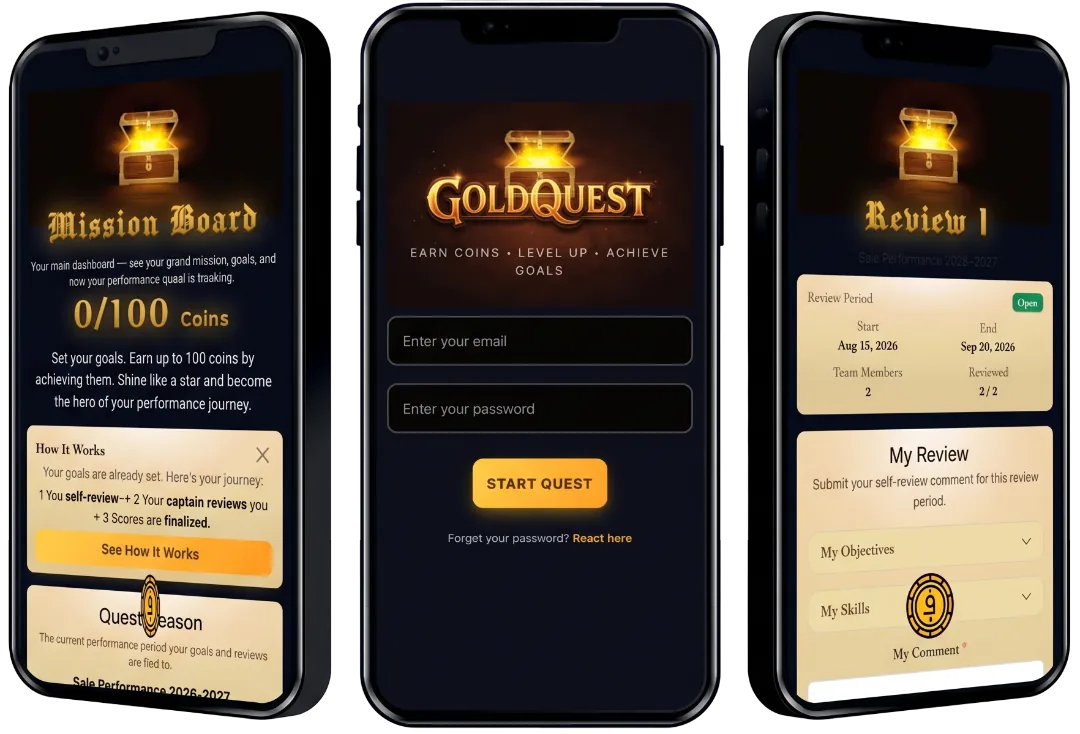
The mobile experience is built, not adapted. Users are pinned to either the desktop console or the mobile interface, with middleware catching anyone who lands on the wrong surface. The whole journey works on a phone — sign-in, the Mission Board, goal editing, the captain review queue, reviews, history, and a How It Works screen. An Android build ships with it.
Live badge counts refresh every thirty seconds, so a captain watches their queue shrink as they work through it. Even the empty states stay in character: "You are not assigned to the current Quest Season" tells someone what to do next, in a way that "No performance cycle record found" never will.
The Gamification That Matters Is the Clarity
Beneath the game language sits a permission-gated application with a dual-surface architecture: one goal-setting engine and one review engine serve both desktop and mobile, so business rules cannot drift apart. The insights layer is deliberately decoupled from the workflows it observes.
The coins, badges and streaks are the layer you add once the foundation tells the truth — not the foundation itself. What makes GoldQuest work is the structural gamification: one vocabulary that makes HR mechanics legible without training, a season with visible stages so progress and blockage are never in doubt, guardrails that enforce the rules instead of merely describing them, and a single score that means the same thing to the employee, the captain and the board.